Bullying in the Workplace…is it still a concern?

Bullying in the workplace has been an ongoing concern, and awareness about its impact on mental health, productivity, and employee retention has increased in recent years. Many organizations have taken steps to address and prevent bullying, including implementing policies and procedures. More companies have established clear guidelines and procedures to identify, report, and address workplace bullying. we have to give credit to the HR professionals. This has helped to create a more supportive and inclusive work environment.

Following up with my study on bullying in the workplace there are things that can be done such as offering training and education. Organizations have focused on training managers and employees to recognize the signs of bullying and handle these situations effectively. This includes promoting a culture of respect and providing resources to support employees who experience bullying. Ensuring that support systems and resources are available. Companies have put in place various support mechanisms, such as employee assistance programs (EAPs), hotlines, and counseling services, to help employees who experience bullying.

What about some legal changes? In some jurisdictions, laws might have been updated or introduced to address workplace bullying, harassment, and discrimination more effectively. This has led to greater accountability for employers and protection for employees. What we are not seeing is “communication” happening in the workplace. Despite these efforts, bullying in the workplace remains a complex and evolving issue. The prevalence of remote work due to the COVID-19 pandemic has led to new forms of cyberbullying and online harassment. It is essential for organizations to remain proactive and adaptive in their approach to tackling workplace bullying, ensuring that all employees feel safe and supported.

With my (2013) study found that witnesses experienced the some of the same as the victims of bullying. The study highlighted that witnesses of workplace bullying experience similar negative effects as the victims underscores the need for continued research and action. The impact on bystanders is an important aspect to consider, as it can contribute to a toxic work environment, reduced productivity, increased stress, and lower employee morale. Companies cannot think that bullying only effects the victims. My view to reduce workplace bullying and its effects on both victims and witnesses, more research should be conducted in the following areas:

  1. Bystander intervention: Studies focusing on effective strategies for bystanders to safely intervene in bullying situations can help empower employees and reduce the occurrence of bullying. These interventions can promote a culture of support and solidarity among employees.
  2. Organizational culture: Research on the factors that contribute to a culture of bullying and how to create a more positive and inclusive work environment can help organizations develop effective prevention strategies. Again, communications needs to happen between the company and the employees.
  3. Psychological impact: More research on the psychological effects of witnessing workplace bullying can provide a deeper understanding of the problem and inform the development of mental health support resources for both victims and bystanders.
  4. Remote work and cyberbullying: With the increase in remote work, research should examine the prevalence and effects of cyberbullying and develop strategies to mitigate this form of harassment in the digital workplace.
  5. Training and education: Studies on the most effective methods for training employees and managers to recognize, prevent, and address bullying can help organizations implement targeted programs that foster a respectful work environment.

By expanding research in these areas, organizations and policymakers can develop a deeper understanding of the causes and consequences of workplace bullying and create more effective strategies to prevent and address it.

Murphy, SV (2013) Perceptions of bullying in the workplace: A phenomenological study:

Posted in Uncategorized | Leave a comment

Workplace Bullying: Still a Silent Epidemic in 2025

Workplace bullying remains a real and painful problem across America — one that hurts not just individuals but entire organizations. Even with more awareness and conversations about it today, bullying at work continues to thrive, often in silence.

When I completed my dissertation in 2013 on workplace bullying from the witness’s perspective, I hoped things would improve. Sadly, updated statistics and expert insights show there is still so much work to do. As I look at where things stand today, I wonder why so many incidents still go unreported and what must change—especially when it comes to leadership and training.

Recent numbers from the 2021 Workplace Bullying Institute Survey show just how widespread this problem is:
• 30% of workers have directly experienced workplace bullying — a 57% jump from 2017.
• 49% of workers have either experienced it or witnessed it.
• Remote workers aren’t exempt — 43% reported bullying even in virtual environments.
• 67% of targets eventually leave their jobs, either forced out or resigning to escape the abuse.
This isn’t a minor issue. It’s a major workforce health crisis that affects millions of lives and costs businesses dearly through lost productivity, turnover, and low morale.

I follow David Yamada; as an expert, I share what David Yamada has to say:
David Yamada, an attorney and law professor at Suffolk University and the author of the Healthy Workplace Bill, has long been a national leader on workplace bullying issues.
On his blog, Minding the Workplace, Yamada recently highlighted two urgent points:
• Workplace bullying disproportionately harms women and marginalized groups.
• Future laws must be trauma-informed — meaning they should recognize the deep psychological wounds bullying causes, not just the financial or professional damage.
He’s pushing for stronger laws to protect employees and provide real accountability—something the U.S. still lacks at the federal level. You can explore more of his work on his site: https://newworkplace.wordpress.com/.

I still question why so many still stay silent. Even though bullying is common, about half of employees who experience it never report it. Why?
• Fear of retaliation or losing their job.
• Belief that management or HR won’t do anything.
• Lack of trust in leadership to handle it reasonably.

This underreporting allows bullies to continue their behavior unchecked, creating toxic cycles that damage companies from the inside out. Witnesses often feel powerless, too, believing they might become the next target if they speak up. I still hold on to a real solution “training, especially for supervisors and consequences towards whom everyone is the bully. Training isn’t just helpful — it’s essential. Organizations must invest in real, ongoing education to:
• Help supervisors and employees recognize bullying behaviors.
• Teach effective, confidential ways to report issues.
• Hold bullies accountable, not protect them.
• Create a workplace culture based on respect and dignity.

Supervisors are key here. They need to be trained not just to spot bullying but also to intervene effectively, protect victims, and prevent retaliation. Some studies show that supervisors are also bullies more than most expect.

If you’re looking for more information, these are excellent places to start:
• Workplace Bullying Institute: https://workplacebullying.org/
• Minding the Workplace https://newworkplace.wordpress.com

Are you a victim of bullying at your workplace?
Have you witnessed bullying at your workplace?

David Yamada's avatarMinding the Workplace

Hello dear readers, over the life of this blog, I’ve sometimes taken aim at certain popular management practices. Here’s a roundup of some of my favorites:

Using the empty rhetoric of change to justify or impose change (2015) (link here) — “With apologies to Bob Dylan, the times are always a-changin’. But if you buy into the rhetoric of certain practitioners of management-speak, then you’d think that the impetus for change occurs at those magic moments when they happen to be in charge.”

“Strategic planning”: All too often, a time-sucking bridge to nowhere (2011) (link here) — “My friends in management consulting may toss me out of the visitor’s lounge for saying this, but two words uttered together send a chill up my spine: Strategic planning. . . . Organizations should engage in smart, inclusive planning and evaluation. But there’s something about mega-processes like strategic planning…

View original post 263 more words

Posted in Uncategorized | Leave a comment

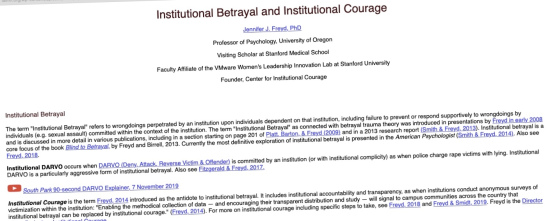
Workplace bullying & mobbing: Applying Jennifer Freyd’s framework of institutional betrayal vs. institutional courage

I recommend following David Yamada’s blog in power & abuse in society, workplace bullying, mobbing, etc. This one focuses on Professor Jennifer Freyd (U. Oregon) sharing how organizations see workplace bullying and mobbing. Very interesting ! There is so much more to do.

David Yamada's avatarMinding the Workplace

Psychology professor Jennifer Freyd (U. Oregon) is helping us to understand organizations in ways that illuminate the dynamics of workplace bullying and mobbing. Last year (link here), I highlighted her work on “DARVO,” which stands for “Deny, Attack, and Reverse Victim and Offender.” I cited DARVO as an important concept for understanding how some workplace aggressors try to play the victim role.

Dr. Freyd’s latest contribution (link here) is framing the distinction between institutional betrayal and institutional courage.

Freyd defines institutional betrayal as “wrongdoings perpetrated by an institution upon individuals dependent on that institution, including failure to prevent or respond supportively to wrongdoings by individuals (e.g. sexual assault) committed within the context of the institution.”

By contrast, institutional courage is “the antidote to institutional betrayal. It includes institutional accountability and transparency, as when institutions conduct anonymous surveys of victimization within the institution.”

When organizations fail to…

View original post 149 more words

Posted in Uncategorized | Leave a comment

Using scholarship to make a difference

Sharing an article David Yamada. Bullying is still plaguing the workforce.

David Yamada's avatarMinding the Workplace

I’ve been spending large chunks of recent weekends working away on a law review article about therapeutic jurisprudence (TJ), the school of legal thought that examines the therapeutic and anti-therapeutic properties of laws, legal systems, and legal institutions. In this article I’m trying to pull together many aspects of TJ as a field of study, scholarship, and practice. As steady readers of this blog may know, I’ve been deeply involved in the TJ community for many years. TJ’s emphasis on the psychological impact of the law and the importance of human dignity has strongly shaped my own thinking and scholarship.

When I first became a law professor, I was skeptical about the potential of legal scholarship to influence law reform. My intention was to do scholarship in sufficient volume and quality to earn tenure, and then to pursue writing and activist projects that didn’t involve lots of citations and footnotes.

View original post 700 more words

Posted in Uncategorized | Leave a comment

Minding the Workplace is 10 years old!

Wow, congrats to David Yamada! Read about the last 10 yrs…and we are still hopeful that a law will be put in place.

David Yamada's avatarMinding the Workplace

Ten years ago this month, I launched this blog. Some 1.1 million page views, 1750+ subscribers, and 1650+ articles later, Minding the Workplace has become a popular source of commentary on work, workers, and workplaces. Thank you, dear readers, for being an integral part of this ongoing journey.

MTW has been a steady platform for pieces about workplace bullying, mobbing, and abuse. I am especially grateful for comments and notes from readers, sharing how this blog has helped them to understand and process their own difficult experiences in the workplace. When I started this blog in 2008, I didn’t anticipate how it could serve that clarifying and validating purpose.

Over the years, MTW has been included in several lists of leading blogs on bullying, organizational psychology, and workplace relations. MTW blog posts are now popping up as sources in academic and professional books and journal articles, which suggests that it…

View original post 151 more words

Posted in Uncategorized | Leave a comment

Pixar animated film captures workplace diversity challenges in 8 minutes

New blog by DAVID YAMADA-Check it out. Workplace Diversity

David Yamada's avatarMinding the Workplace

Pixar has released a great little animated film that beautifully captures the challenges of building workforce diversity in the midst of a white male “bro” culture, starring a ball of yarn named Purl. Emily Canal, writing for Inc., explains:

In Pixar’s new animated short, Purl enters the office on her first day of work and quickly realizes she doesn’t look or behave like the other employees. For starters, they’re all white men clad in identical suits and acting just like their company’s name, B.R.O. Capital, might suggest. Meanwhile, Purl is a fuzzy pink ball of yarn.

…The short emphasizes the importance of workplace inclusivity and diversity as Purl is ignored, shut down at meetings, and excluded from out-of-office bonding events simply because she’s different. The film’s writer and director, Kristen Lester, drew on her own experiences in the animation industry for Purl’s story. 

“My first job, I was…

View original post 96 more words

Posted in Uncategorized | Leave a comment

Are workplace abusers “emotional terrorists”?

This is a very informative blog by David Yamada. Please share your thoughts.

David Yamada's avatarMinding the Workplace

Edvard Munch’s “The Scream” (1893)

In my last post, I discussed a lengthy investigative piece in Variety magazine from December, detailing the story behind Live Nation Entertainment’s decision to place leading producer Heather Parry (“A Star is Born”) on leave, in the wake of multiple accusations of severe workplace bullying and verbal abuse. The Variety piece is loaded with anecdotes from former Live Nation employees, including this one from one-time development executive Wynn Wygal:

Wynn Wygal went to work as a development executive at Live Nation Prods. in November 2017. She said she immediately noticed that her colleagues tensed up whenever Parry walked by.

Wygal soon found that she was prone to angry outbursts, and her moods were impossible to predict.

“Heather berated me on a regular basis for a whole slew of trivial reasons,” Wygal says. “She didn’t like my tone of voice on a call. She…

View original post 372 more words

Posted in Uncategorized | Leave a comment

A Commonwealth employee passes away on the job after administrators allegedly refused to accept her doctor’s note

Oh my goodness! At what point will the system recognize that we have to deal with this bullying in the workplace issue. Please read the MA Healthy Workplace blog. If you have a story to share, see the email. The education has to continue.

Posted in Uncategorized | Leave a comment

Sarkis: How to identify a gaslighter

Enjoy this, it is crucial to understand and know what you are dealing with. Sarkis: How to identify a gaslighter by David Yamada…

David Yamada's avatarMinding the Workplace

Joining the growing literature on gaslighting behaviors is Dr. Stephanie Sarkis’s Gaslighting: Recognize Manipulative and Emotionally Abusive People — and Break Free (2018). Sarkis is both a counselor and a mediator, and her experiences in clinical practice brought gaslighting and gaslighters to her attention. The results of her work make for this welcomed contribution to our understanding.

Dr. Sarkis writes:

Gaslighters will convince us that we are crazy, that we are abusive, that we are a huge bundle of problems and no one else will want us, that we are terrible employees who haven’t been fired yet just by the grace of God, that we are terrible parents who shouldn’t have had children, that we have no idea how to manage our own life, or that we are a burden to others. They are toxic.

…Gaslighters use your own words against you; plot against you, lie to your face, deny your needs, show…

View original post 348 more words

Posted in Uncategorized | Leave a comment

How administrators bullied a state hospital nurse after workplace violence

Sharing info from the Massachusetts Healthy Workplace Bill -A behind-the-scenes look at the making of the bill into law blog. This is a concern, you are hear the voice of the victim. If you have comments please share. I believe there should be more discussions about bullying in the workplace.

Posted in Uncategorized | Leave a comment